Robotic rehabilitation uses powered devices, sensors, and software to help people practice movements after neurological injury, surgery, or other conditions that limit mobility. Its central scientific premise is that repeated, task-specific practice—adjusted to a person’s ability and paired with feedback—can support motor learning and functional recovery. Evidence is promising but not uniform: the value of a robot depends on the condition, the movement trained, the treatment dose, and whether gains transfer to everyday activities. This article explains how robotic rehabilitation works, reviews its main device types and clinical evidence, and considers safety, access, and future directions.
Robotic rehabilitation combines assistive technology with motor-learning principles
Robotic rehabilitation is the use of a programmable electromechanical device to assist, resist, measure, or guide a person’s movement during therapy. The U.S. Food and Drug Administration describes rehabilitation devices within the broader category of medical devices intended to support or restore physical function; in clinical practice, the term covers systems ranging from stationary arm-training robots to wearable exoskeletons. These systems do not independently “repair” the nervous system. Instead, they can make practice more repeatable, measurable, and adjustable while a therapist supervises treatment.
The approach matters because neurological conditions can leave people needing substantial practice to regain movement. The World Health Organization estimates that 1 in 3 people worldwide live with a health condition that could benefit from rehabilitation. Stroke is a major source of adult disability, and the American Heart Association reports that about 795,000 people in the United States experience a stroke each year. Robotic systems are therefore relevant both as tools for delivering therapy and as measurement platforms that record movement performance over time.
The science of repetition, task specificity, and feedback
Motor learning is a relatively lasting change in the ability to perform a movement, developed through practice and feedback. Robotic devices can support this process by helping a patient complete many repetitions of a task, such as reaching toward a target or stepping through a gait cycle. Their sensors can record position, speed, force, and range of motion, allowing the system or therapist to adjust assistance as the patient’s capacity changes. Repetition alone is not enough: practice is most useful when it is relevant to the person’s goals and sufficiently challenging without being unsafe or discouraging.
Assistance, resistance, and assist-as-needed control
Robots can apply different control strategies. In “passive” or fully assisted training, the device guides a limb through a prescribed path; in active-assist training, it contributes only when the patient cannot complete the movement; and in resistive training, it provides a controlled load for strengthening or coordination. Assist-as-needed approaches aim to provide the minimum support required to finish a task, preserving active effort while enabling successful practice. The appropriate strategy depends on clinical assessment, fatigue, safety, and the specific movement being retrained.
Robotic rehabilitation devices target different movements and settings
The device category is broad, and each design has different strengths. A stationary end-effector robot moves a limb through a handle or footplate; an exoskeleton aligns powered joints with the user’s body; and wearable systems provide assistance during standing or walking. These are useful distinctions because a device that supports seated reaching is not automatically suitable for balance training or independent community walking.
Upper-limb robots for reaching and arm practice
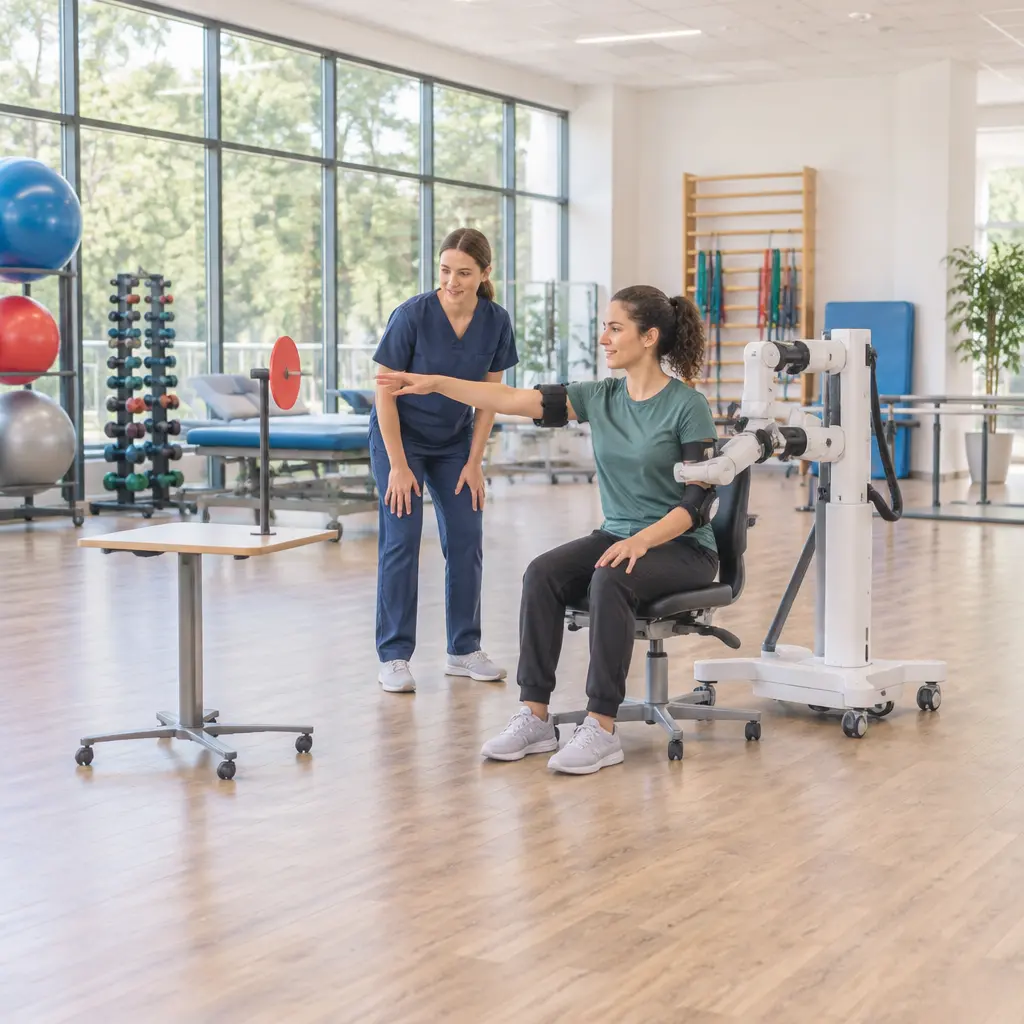
Upper-limb rehabilitation robots train shoulder, elbow, wrist, or hand movements. Some guide the arm in a horizontal plane, while others use an exoskeleton-like frame or a robotic hand interface. Many present visual targets or games, which can make repeated reaching more engaging and provide immediate performance feedback. A 2018 Cochrane review of electromechanical and robot-assisted arm training after stroke found that such training may improve activities of daily living, arm function, and arm strength, although results varied across studies and treatment programs. The review emphasized that robot-assisted practice is generally an addition to, rather than a replacement for, conventional rehabilitation.
Gait robots and lower-limb exoskeletons
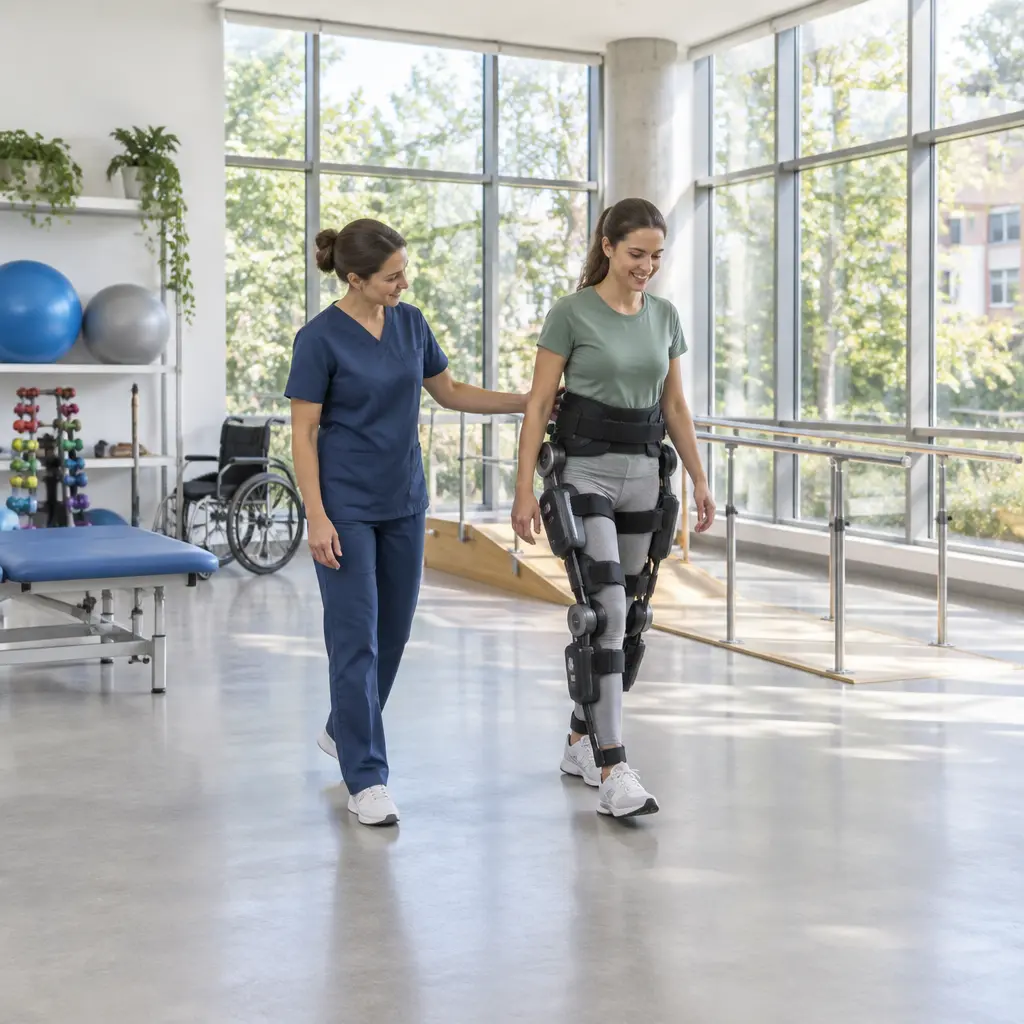
Gait-training systems include treadmill-based devices that move a person’s legs through a walking pattern and wearable exoskeletons that assist hip, knee, or ankle motion. Body-weight support may be used to reduce the load on the legs while a patient practices stepping. These systems can help clinicians deliver structured walking repetitions, but walking speed, endurance, balance, and safe community mobility are separate outcomes and should be assessed separately. The American Heart Association and American Stroke Association’s stroke rehabilitation guidance supports considering electromechanical gait training for selected patients, especially when conventional walking practice is difficult, while stressing that patient selection and the broader rehabilitation plan remain important.
Soft wearable robots and rehabilitation outside the clinic
Soft wearable robots use flexible textiles, cables, or pneumatic components rather than rigid frames to assist movement. Their lighter construction may improve comfort and portability, though they still require careful fitting and clinical validation. Related technologies include sensor-equipped garments and home-based devices that track exercise completion. Remote monitoring can extend practice beyond a clinic, but it does not remove the need for professional assessment, device training, or a plan for responding to pain, falls, or technical problems.
Robotic rehabilitation has measurable benefits, with important limits
Research has tested robotic rehabilitation in stroke, spinal cord injury, multiple sclerosis, cerebral palsy, and orthopedic recovery. Results should be interpreted by diagnosis and outcome rather than generalized across all robots. A device may improve the number of repetitions or a test score without producing a comparable change in dressing, household tasks, or independent mobility. Clinicians therefore track both impairment-level measures—such as joint range or muscle strength—and activity-level goals that matter in daily life.
What stroke research shows
Stroke is among the most studied applications. The 2018 Cochrane review of electromechanical and robot-assisted arm training included 45 trials and 1,619 participants. It reported evidence that these interventions may improve arm function and activities of daily living, but the certainty and size of benefit differed by outcome and study. For walking after stroke, a 2020 Cochrane review found that electromechanical-assisted gait training combined with physiotherapy may increase the chance of achieving independent walking, particularly in people early after stroke who cannot yet walk independently. These findings support selective use, not the assumption that every patient or device will benefit equally.
Real-world example: pairing robotic practice with functional goals
Consider a person recovering from stroke who has difficulty reaching and grasping a cup. A therapist might use an arm robot to provide supported repetitions toward targets, gradually reducing assistance as control improves. The clinical program should then test whether the person can reach for an actual cup, stabilize it, and bring it to the mouth in a practical setting. This progression—from device-assisted movement to meaningful task practice—illustrates why robotics is best treated as one component of a goal-driven rehabilitation plan rather than an endpoint in itself.
Why study results do not always translate directly to daily life
Trials differ in device design, therapy dose, patient severity, timing after injury, and the amount of therapist-led practice. Some compare robotics with usual care, while others compare it with an equal amount of conventional training; those comparisons answer different questions. Outcomes may also reflect the added practice time rather than a unique effect of the robot. A strong clinical decision therefore considers whether the device enables a meaningful increase in safe, high-quality practice and whether progress transfers to activities outside the machine.
Robotic rehabilitation requires individualized safety and clinical oversight
A rehabilitation robot is a medical tool, not a substitute for diagnosis or professional judgment. Therapists assess strength, sensation, joint range, cognition, balance, pain, skin condition, and the person’s ability to follow instructions before selecting a device. They also monitor fatigue, blood pressure when appropriate, discomfort, and changes in movement quality. Equipment must be fitted and calibrated correctly; for wearable systems, poor alignment can cause pressure, discomfort, or unwanted joint loading.
Potential risks and practical precautions
Possible problems include skin irritation, excessive fatigue, pain, loss of balance, and movement patterns that reinforce compensation rather than useful control. A person with reduced sensation may not notice pressure or friction, making frequent skin checks important. For exoskeleton walking, trained supervision and an appropriate environment are essential because a device cannot eliminate fall risk. Treatment should stop or be modified if symptoms worsen, and device-specific instructions and contraindications should be followed.
Access, cost, and therapist expertise
Robotic systems can be expensive to purchase, maintain, and staff, and access differs among hospitals, rehabilitation centers, and regions. Their value depends partly on whether they improve treatment delivery enough to justify those costs. Organizations should evaluate total costs—including training, setup time, service, and space—alongside clinical outcomes and patient experience. Therapists also need training to select suitable tasks, adjust assistance, interpret device data, and integrate robotic practice with conventional therapy.
Future research is moving toward adaptive and connected rehabilitation
Newer systems combine robotics with wearable sensors, virtual environments, and data analysis. Adaptive controllers may adjust assistance in response to a person’s performance, while connected devices may help clinicians review practice completed at home. These developments could support more personalized therapy, but claims of improved recovery require well-designed clinical trials. Researchers need to establish which patients benefit, what dose is effective, whether improvements persist, and how device-based outcomes relate to meaningful participation in daily life.
A useful evidence display would plot change in a functional outcome—such as walking independence or arm activity—against treatment dose, with separate series for device type and patient group. Such a chart would make clear why a single average effect can conceal differences in timing, severity, and training protocol. Until the evidence is more consistent, the best-supported approach is to use robots selectively, measure outcomes transparently, and preserve the therapist–patient relationship that helps translate practice into real-world function.
Conclusion: robotic rehabilitation is a tool for purposeful practice
Robotic rehabilitation applies controlled assistance, repetition, and measurement to movement training. Upper-limb robots, gait systems, exoskeletons, and soft wearables each address different needs, and research—particularly in stroke rehabilitation—shows potential benefits for selected outcomes. Those benefits are not automatic: safety, patient selection, treatment dose, therapist expertise, and transfer to daily activities all matter. Patients and care teams can use the evidence most effectively by setting functional goals, asking how progress will be measured, and treating robotics as part of a broader rehabilitation program. For further reading, consult the World Health Organization’s rehabilitation resources, Cochrane reviews, and current professional stroke-rehabilitation guidelines.
Sources: World Health Organization, Rehabilitation, https://www.who.int/news-room/fact-sheets/detail/rehabilitation; American Heart Association, Heart Disease and Stroke Statistics—2024 Update, https://www.ahajournals.org/doi/10.1161/CIR.0000000000001209; Mehrholz J, Pohl M, Platz T, Kugler J, Elsner B, Electromechanical and robot-assisted arm training for improving activities of daily living, arm function, and arm muscle strength after stroke, Cochrane Database of Systematic Reviews, 2018, https://doi.org/10.1002/14651858.CD006876.pub5; Mehrholz J, Thomas S, Kugler J, Pohl M, Elsner B, Electromechanical-assisted training for walking after stroke, Cochrane Database of Systematic Reviews, 2020, https://doi.org/10.1002/14651858.CD006185.pub5; Winstein CJ et al., Guidelines for Adult Stroke Rehabilitation and Recovery, American Heart Association/American Stroke Association, 2016, https://www.ahajournals.org/doi/10.1161/STR.0000000000000098; U.S. Food and Drug Administration, Rehabilitation Devices, https://www.fda.gov/medical-devices/products-and-medical-procedures/rehabilitation-devices.