
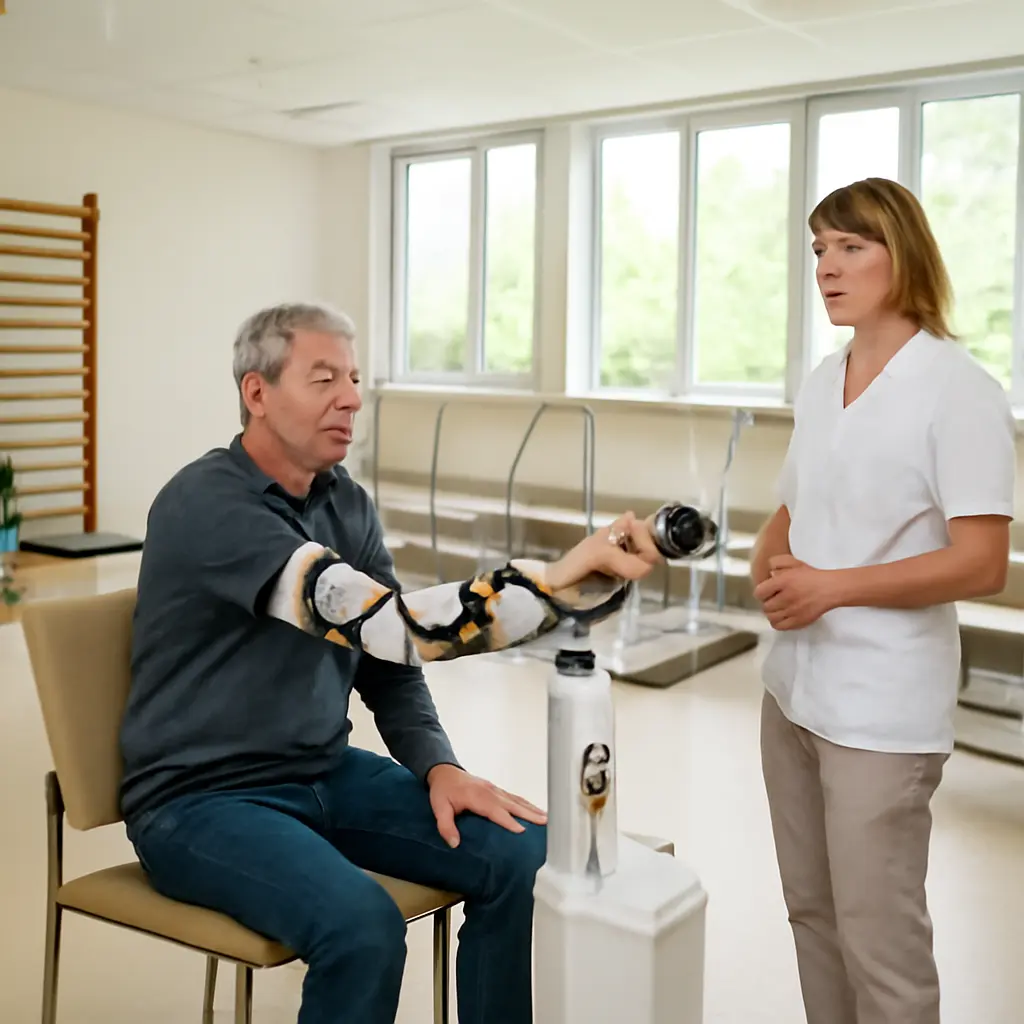
Stroke recovery is increasingly understood as more than rebuilding strength: it is the process of relearning coordinated, purposeful movement. Robotic rehabilitation devices make motion measurable, allowing clinicians and researchers to track how much a person moves, how smoothly they move, and how assistance affects performance. Evidence supports robotic therapy as a way to deliver repeatable, high-volume practice, but it does not show that a robot is a cure or a substitute for individualized rehabilitation. Its clearest value is helping people practice and helping care teams observe progress—an important distinction as stroke remains a major global cause of disability.
Robotic therapy reveals motion through measurable rehabilitation
Robotic stroke therapy uses powered or mechanically guided devices to support repetitive movement practice after a stroke. Depending on the device, a patient may move an arm, hand, wrist, leg, or ankle while the system records motion and adjusts assistance. The resulting data can describe range, speed, smoothness, force, and task completion—features that a simple strength test may not capture. The World Health Organization estimates that about 15 million people experience a stroke each year worldwide; the World Stroke Organization has also reported that more than 100 million people are living with stroke’s effects. These figures underscore why accessible, effective rehabilitation matters.
Robotic therapy defines motion as both a treatment target and a measurement
There is no single universally accepted definition of “motion” in robotic rehabilitation. In practice, it refers to observable movement during a task: its amount, direction, timing, force, and coordination. The American Stroke Association describes rehabilitation as a process of relearning skills and adapting to changes caused by stroke; robotic systems add instruments that can quantify some parts of that process. They may record how far a limb travels, whether the patient initiates movement, and how much the device contributes.
The distinction matters: a device’s movement score is not, by itself, proof that a person can use the limb effectively in daily life. Clinical assessment still needs to consider activities such as reaching for a cup, dressing, walking safely, and participating in family or work life. Robotic measurements are best interpreted alongside therapist observation and validated functional assessments.
Assisted movement and active practice
Assisted movement occurs when a robot guides or helps a limb complete a motion. In active practice, the patient contributes effort, and the device may provide only the support needed to finish the task. Many systems can adjust assistance as performance changes. This makes it possible to repeat a movement while limiting fatigue or compensatory strategies, although the appropriate level of help depends on the individual and the rehabilitation goal.
Kinematics, kinetics, and movement quality
Kinematics describes movement—such as position, distance, speed, and trajectory—while kinetics concerns the forces involved. A robot can capture these features repeatedly under similar conditions, potentially revealing changes that are difficult to judge by eye. For example, a patient may reach farther but do so more slowly, or move quickly while relying on the trunk rather than the shoulder. Measurement helps clinicians ask more precise questions, but it must be linked to meaningful function rather than treated as a stand-alone outcome.
These measures set the stage for understanding the main device categories: different robots target different body parts and rehabilitation tasks.
Robotic therapy devices target distinct movement patterns
Robotic rehabilitation includes several device types rather than one standard machine. The National Institute for Health and Care Excellence and rehabilitation researchers describe systems that support upper-limb practice, gait training, and other task-specific movement. Their benefits and limitations differ by the impairment being treated, the person’s ability to participate, and the broader therapy program.
Arm and hand robots
Upper-limb robots support reaching, elbow and shoulder movement, wrist control, or hand opening and grasping. Some are end-effector devices, where the patient holds or pushes a handle; others are exoskeletons, which align mechanical supports with the arm’s joints. These systems can help deliver many repetitions of reaching or grasping practice. The 2018 Cochrane review of electromechanical and robot-assisted arm training found that such training may improve activities of daily living, arm function, and arm strength, but the results vary across studies and do not establish that every device or treatment schedule works equally well.
Gait and lower-limb robots
Gait robots support leg movement during walking practice, often using a treadmill, body-weight support, or a powered exoskeleton. They can help people practice stepping when independent walking is difficult, while therapists supervise posture, safety, and effort. A 2020 Cochrane review of electromechanical-assisted training for walking after stroke concluded that combining these devices with physiotherapy may increase the chance of regaining independent walking, particularly for some people early after stroke. The finding is not a guarantee for an individual patient, and gait devices do not replace balance, endurance, and real-world walking practice.
Wearable and sensor-based systems
Wearable robotic systems and sensor-based tools track or assist movement outside conventional clinic equipment. They may use braces, powered joints, motion sensors, or feedback interfaces. Their promise is to connect supervised practice with repeated movement in everyday settings. However, availability, cost, comfort, and evidence for long-term benefits remain important considerations. A device that records more motion does not automatically ensure that the movement is safe, useful, or sustained at home.
Robotic therapy reveals how practice, feedback, and recovery interact
Robots can make practice consistent and provide immediate information, but recovery depends on more than repetition. Stroke can affect sensation, attention, balance, planning, and motivation as well as muscle control. Rehabilitation therefore needs to adapt the task, difficulty, feedback, and assistance to the person’s changing abilities.
Repetition and task-specific learning
Task-specific practice means rehearsing movements that relate to a desired activity. A robot may help a patient repeat reaching or stepping, but useful rehabilitation also connects those actions to everyday goals. The American Heart Association and American Stroke Association’s adult stroke rehabilitation guideline emphasizes coordinated, individualized care. Repetition is valuable when it is purposeful, sufficiently challenging, and integrated with functional training—not simply because a machine can count a large number of movements.
Feedback and patient effort
Visual, auditory, or haptic feedback can show a patient how a movement is progressing. A robot may display a trajectory, signal when a target is reached, or modify support in response to effort. Feedback can help people notice performance and stay engaged, but too much assistance may reduce the effort required for active learning. Therapists must balance support with challenge and monitor pain, fatigue, frustration, and movement quality.
Neuroplasticity and individual recovery
Neuroplasticity is the nervous system’s capacity to change through experience and learning. Repeated, meaningful practice is one way rehabilitation seeks to encourage useful adaptations after stroke. Robotic devices can support practice and document movement, but they do not directly measure brain repair, and a device-generated score should not be confused with evidence of a specific neural mechanism. Recovery varies with stroke severity, lesion location, health, time since stroke, and access to therapy.
Robotic therapy evidence shows promise alongside important limits
Research supports robotic therapy as a possible way to increase structured practice and, for certain outcomes and patient groups, improve function. Systematic reviews also show variation in devices, treatment intensity, participant characteristics, and outcome measures. That variation makes broad claims difficult: “robotic therapy works” is less informative than asking which device, for whom, at what stage, for which task, and compared with what alternative.
What the research supports
The Cochrane reviews of upper-limb and walking rehabilitation report potential benefits in selected outcomes, while emphasizing differences among trials. A practical advantage is that devices can deliver repeatable training and record performance. This can help teams monitor change and tailor sessions. Evidence is strongest when robotic practice is viewed as part of a broader rehabilitation plan rather than a stand-alone intervention or a guaranteed route to independence.
Safety, access, and clinical judgment
Robotic sessions require appropriate assessment and supervision. Clinicians consider medical stability, joint range, pain, skin integrity, cognition, balance, and the ability to follow instructions. Equipment can be costly, may not be available in every care setting, and can require staff training. The technology also raises practical questions about fitting, maintenance, accessibility, and whether improvements transfer to activities outside the device. These factors should be discussed with a rehabilitation team before treatment begins.
Robotic therapy changes how recovery is discussed, not who directs it
The most useful insight from robotic rehabilitation is that movement can be both practiced and measured in greater detail. Devices can reveal patterns in range, speed, assistance, and consistency, while helping deliver repeated task practice. Evidence indicates possible benefits for arm function and walking in some settings, yet outcomes depend on the person, intervention, and goal. The broader implication is a more data-informed approach to rehabilitation—not a replacement for skilled clinicians or patient-centered care.
People considering robotic therapy can ask their rehabilitation team what functional goal the device addresses, how progress will be measured, how the practice connects to daily activities, and what alternatives are available. For further context, consult stroke rehabilitation guidance from the American Heart Association and American Stroke Association, and discuss individual treatment decisions with qualified health professionals.
Sources: World Health Organization, “Stroke,” https://www.who.int/news-room/fact-sheets/detail/stroke; World Stroke Organization, “Global Stroke Fact Sheet 2022,” https://www.world-stroke.org/assets/downloads/WSO_Global_Stroke_Fact_Sheet.pdf; American Stroke Association, “About Stroke Rehabilitation,” https://www.stroke.org/en/life-after-stroke/stroke-rehab; Mehrholz J, Pohl M, Platz T, Kugler J, Elsner B, “Electromechanical and robot-assisted arm training for improving activities of daily living, arm function, and arm muscle strength after stroke,” Cochrane Database of Systematic Reviews, 2018, https://doi.org/10.1002/14651858.CD006876.pub5; Mehrholz J, Thomas S, Werner C, Kugler J, Pohl M, Elsner B, “Electromechanical-assisted training for walking after stroke,” Cochrane Database of Systematic Reviews, 2020, https://doi.org/10.1002/14651858.CD006185.pub5; Winstein CJ et al., “Guidelines for Adult Stroke Rehabilitation and Recovery,” Stroke, American Heart Association/American Stroke Association, 2016, https://doi.org/10.1161/STR.0000000000000098.


