Robotic rehabilitation is therapy that uses robotic devices to support, guide, or measure movement practice after an injury or illness. Results may appear within a few sessions, but meaningful changes in walking, arm use, or daily activities typically require repeated training over several weeks—and the timeline varies with the person’s diagnosis, starting ability, therapy dose, and goals. Research reviews report benefits from robot-assisted training for some outcomes, especially when it complements conventional rehabilitation, but they do not establish one universal “time to results.” The practical way to judge progress is to track specific functional measures at regular intervals with a rehabilitation professional.
Robotic Rehabilitation and Time to Results
Robotic rehabilitation is a form of technology-assisted therapy in which a device helps a person perform repeated movements, provides feedback, or adjusts assistance to their ability. Examples include powered gait trainers, treadmill-based exoskeletons, and devices that assist arm and hand movement. Results can mean different things: completing more repetitions during a session, improving a clinical test score, walking farther, or becoming more independent at home.
The distinction matters because an early improvement in practice is not necessarily a lasting change in everyday function. A person may tolerate longer sessions before their walking speed changes, for example. The National Institute for Health and Care Excellence (NICE) and clinical rehabilitation guidance emphasize individualized, goal-focused care; device use should be selected as part of a treatment plan rather than treated as a guaranteed shortcut.
What “results” can mean
Results are measurable changes relevant to an individual’s goals. Therapists may assess impairment, such as strength or range of motion; activity, such as walking speed or arm-task performance; and participation, such as managing daily routines. A systematic review by Mehrholz and colleagues in the Cochrane Database of Systematic Reviews found that electromechanical and robot-assisted gait training after stroke, when combined with physiotherapy, can improve the chance of regaining independent walking. That finding supports potential benefit, but it does not mean every person improves within the same number of days or weeks.
Why timelines differ
Recovery depends on the condition being treated, its severity, time since onset, other health conditions, fatigue, cognition, motivation, and the amount of meaningful practice. Device type and settings also matter: some systems provide substantial assistance, while others challenge the user to contribute more actively. The World Health Organization’s rehabilitation framework describes rehabilitation as a person-centered process shaped by health, functioning, and environmental context—not a fixed-duration intervention.
Robotic Rehabilitation Timelines by Treatment Type
Different robotic systems train different abilities, so timelines are best understood by treatment category. Across categories, early sessions help establish tolerance, fit, and safe technique. A clinician then reviews whether the training is producing changes that transfer beyond the device.
Gait and walking rehabilitation
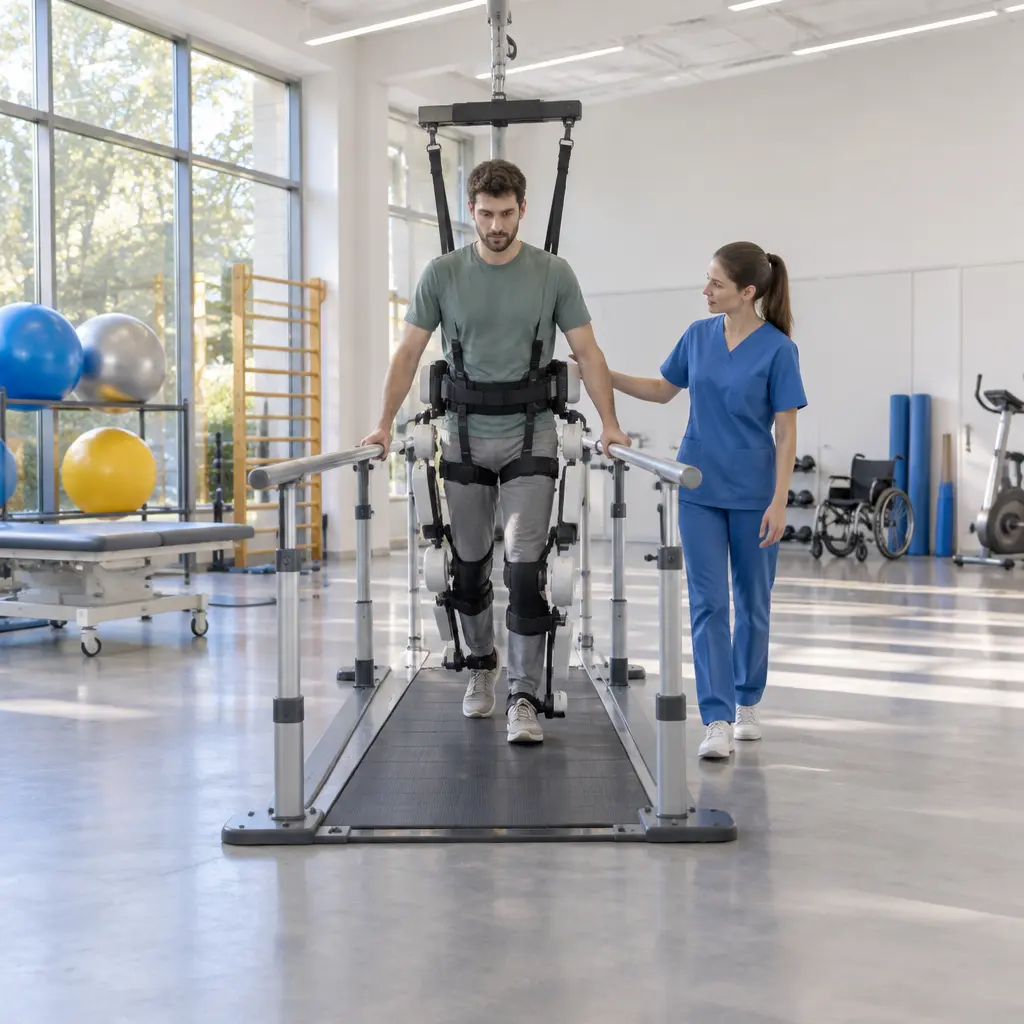
Robotic gait training uses a powered gait orthosis, wearable exoskeleton, or treadmill-linked system to practice stepping. Some users notice that they can complete more steps or sustain practice in the first sessions. Changes in walking independence, speed, endurance, or balance usually require a course of repeated sessions and should be measured over time with tools such as the 10-Meter Walk Test, 6-Minute Walk Test, or Functional Ambulation Category.
In a Cochrane review of people after stroke, electromechanical-assisted gait training combined with physiotherapy increased the likelihood of becoming independently ambulatory compared with physiotherapy alone, with the clearest benefit reported in people who were not independently walking at the start. This is a group-level finding, not a prediction for an individual. The same review did not establish a single optimal schedule or guarantee that gains would emerge after a particular number of sessions.
Arm and hand rehabilitation
Upper-limb robotic therapy assists repeated reaching, grasping, or elbow and shoulder movements, often after stroke or neurological injury. Early changes may include greater movement repetitions or reduced assistance required by the device; meaningful improvements in reaching, self-care, or hand use may take several weeks of practice and may continue after the formal course.
The American Heart Association/American Stroke Association’s stroke rehabilitation guidance describes repetitive, task-specific practice as a central rehabilitation approach. A review by Mehrholz and colleagues on electromechanical and robot-assisted arm training found improvements in activities of daily living and arm function in some analyses, while results varied across studies. Because devices and study protocols differ, clinicians should combine robotic practice with functional tasks and reassess real-world arm use rather than relying only on machine scores.
Exoskeleton and mobility training
Wearable robotic exoskeletons support standing and stepping for selected people with spinal cord injury, stroke, or other mobility limitations. Progress may first show up as safer transfers, longer standing tolerance, or improved ability to complete a supervised walking session. These systems require screening, fitting, and training; they are not suitable for everyone, and device-assisted walking does not automatically translate into independent community mobility.
A 2017 systematic review by Miller and colleagues on powered exoskeletons after spinal cord injury reported that training studies generally involved repeated supervised sessions, but protocols and participant outcomes varied considerably. Therefore, any timeline should be based on the person’s specific diagnosis, safety profile, and goals, with progress evaluated by the clinical team.
Robotic Rehabilitation Progress and How It Is Measured
A useful progress check distinguishes capacity inside the clinic from performance in daily life. A device may record repetitions, range, walking time, or assistance level, while standardized clinical assessments capture whether those practice gains improve function. The therapist can set a baseline before treatment and repeat the same measures at planned intervals.
Early indicators during the first sessions
Early indicators include tolerating the device, completing more repetitions, needing less assistance, or showing more controlled movement. These are valuable signs that training is feasible, but they should not be confused with a confirmed long-term outcome. Pain, unusual fatigue, skin irritation, dizziness, or worsening symptoms should be reported promptly so the team can adjust the plan.
Functional outcomes over a course of therapy
Functional outcomes measure whether a person can perform useful activities more effectively. For walking, clinicians may track speed, distance, balance, and level of assistance. For arm rehabilitation, they may measure reach, grasp, dexterity, and daily task performance. The International Classification of Functioning, Disability and Health (ICF), developed by the World Health Organization, provides a framework for considering body functions, activities, participation, and environmental factors together.
Illustrative progress chart
A useful chart for a treatment plan would show baseline, review-point, and end-of-course scores for the person’s chosen measure—for example, walking speed or an upper-limb task score—alongside session attendance and assistance level. There is no responsible universal curve to display: published trials use different devices, populations, schedules, and outcome measures. A clinician should interpret trends against the person’s baseline and the test’s measurement limits.
Factors That Affect How Quickly Robotic Rehabilitation Works
Diagnosis, severity, and starting function
The diagnosis and initial level of function strongly influence both the treatment goal and the pace of change. For example, someone who can already walk with assistance may focus on speed or endurance, while someone unable to step independently may first work toward supported standing or stepping. Stroke, spinal cord injury, multiple sclerosis, cerebral palsy, and orthopedic conditions have different recovery patterns, so results from one population should not be applied uncritically to another.
Training frequency and practice quality
The amount of therapy matters, but so does the quality of practice. Repeated, goal-directed movement with appropriate challenge may be more useful than simply spending time in a device. A therapist may adjust assistance, speed, rest breaks, or task difficulty to encourage active participation while maintaining safety. The American Stroke Association notes the importance of repetitive, task-specific rehabilitation after stroke, though the appropriate dose depends on individual tolerance and clinical needs.
Consistency, recovery, and transfer to daily life
Attendance and practice between sessions can influence progress, as can sleep, nutrition, mood, pain, and other medical conditions. Improvements should also be checked outside the device: a person may need conventional therapy, home practice, assistive equipment, or environmental changes to use a newly trained skill in everyday settings. Robotic rehabilitation is generally most useful as one component of a broader rehabilitation program.
Setting Expectations and Reviewing the Treatment Plan
Before starting, ask the rehabilitation team which specific outcome the device is intended to improve, how it will be measured, how often progress will be reviewed, and what signs would lead to changing the plan. Agree on a practical goal, such as walking a defined distance with less assistance or using the affected arm during a daily task. If repeated assessments show no meaningful progress, the team can reconsider the device, training dose, goals, or additional barriers.
The evidence supports robotic devices as potentially helpful tools for selected rehabilitation goals, not as a guaranteed or universally faster route to recovery. A fair assessment combines device performance, standardized functional measures, safety, and the person’s experience in daily life.
Conclusion: Robotic Rehabilitation Results Are Individual
Robotic rehabilitation may produce immediate practice gains, while meaningful changes in mobility, arm use, or independence generally need repeated training and regular assessment. Gait training, upper-limb robotics, and exoskeleton programs each target different outcomes, and research—including Cochrane reviews—shows potential benefits for selected groups without defining one universal timeline. Discuss measurable goals with a rehabilitation professional, track progress from a clear baseline, and review whether improvements transfer to everyday activities.
Sources: Mehrholz et al., Electromechanical-assisted training for walking after stroke, Cochrane Database of Systematic Reviews, 2020, https://doi.org/10.1002/14651858.CD006185.pub5; Mehrholz et al., Electromechanical and robot-assisted arm training for improving activities of daily living, arm function, and arm muscle strength after stroke, Cochrane Database of Systematic Reviews, 2018, https://doi.org/10.1002/14651858.CD006876.pub5; Winstein et al., Guidelines for Adult Stroke Rehabilitation and Recovery, American Heart Association/American Stroke Association, 2016, https://doi.org/10.1161/STR.0000000000000098; World Health Organization, International Classification of Functioning, Disability and Health (ICF), https://www.who.int/standards/classifications/international-classification-of-functioning-disability-and-health; Miller et al., The impact of powered exoskeletons on walking ability and balance in individuals with spinal cord injury: a systematic review and meta-analysis, Journal of NeuroEngineering and Rehabilitation, 2017, https://doi.org/10.1186/s12984-017-0274-4; National Institute for Health and Care Excellence, Stroke rehabilitation in adults, NICE guideline NG236, 2023, https://www.nice.org.uk/guidance/ng236.